
In 2026, the landscape of digital marketing has shifted from manual outreach to intelligent, automated prospecting. If you are a beginner wondering how to keep up with the competition, the answer lies in understanding how to use AI tools for lead generation beginners. This shift is particularly impactful for B2B prospecting, where precision is key.
Gone are the days of spending hours scrolling through LinkedIn or manually searching for email addresses. Today, AI allows you to identify, qualify, and engage prospects with surgical precision.
By integrating artificial intelligence into your sales stack, you can increase your lead conversion rates by up to 3x. This guide will walk you through the essential strategies, tools, and best practices on how to use AI tools for lead generation beginners to help you build a robust pipeline that generates high-quality leads while you focus on closing deals and achieving robust sales funnel optimization.
Why Beginners Must Embrace AI for Lead Generation in 2026
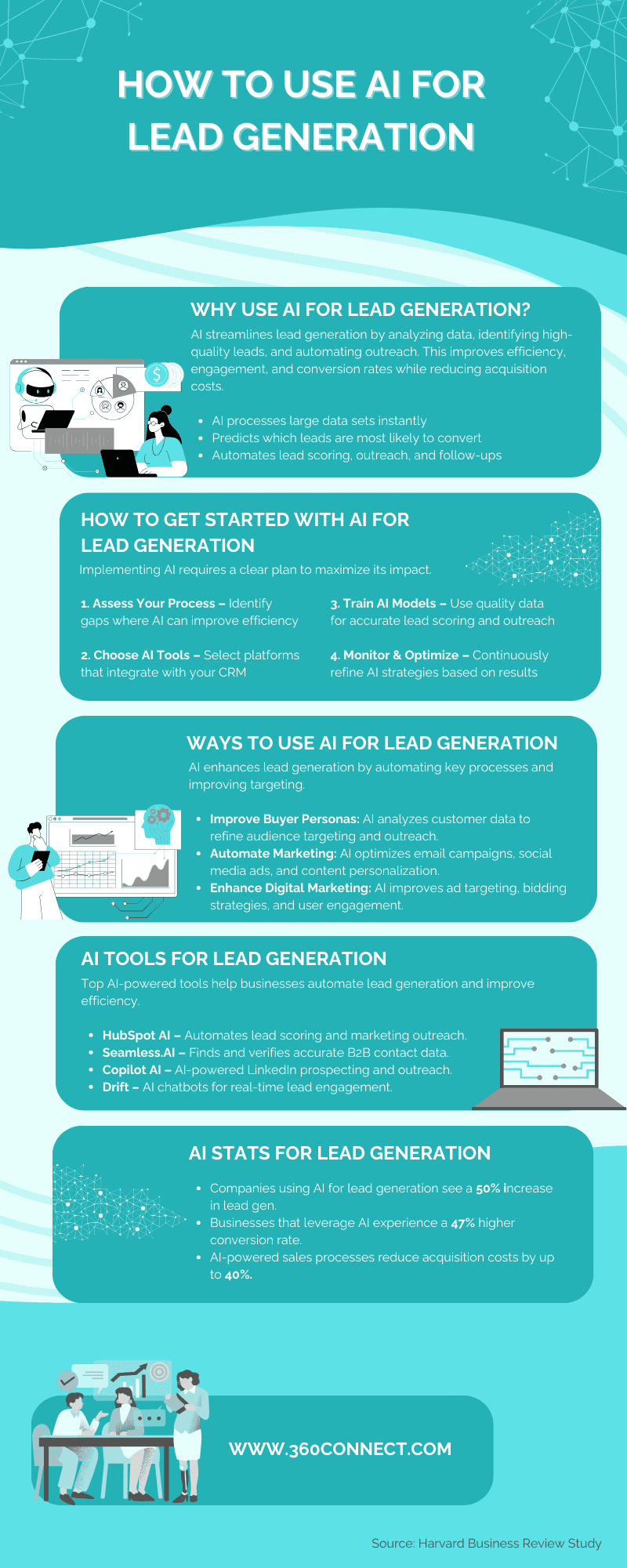
For small businesses and solo founders, time is your most valuable asset. Traditional lead generation is often a “spray and pray” approach that wastes time on unqualified leads. Understanding how to use AI tools for lead generation beginners changes the game by automating repetitive tasks such as data enrichment, prospect research, and initial outreach. This provides invaluable data-driven insights for better decision-making.
When you learn how to use AI tools for lead generation beginners, you aren’t just working faster; you are working smarter. AI algorithms, powered by advanced machine learning algorithms, analyze vast datasets to predict which leads are most likely to convert, allowing you to prioritize your efforts through powerful predictive analytics. According to industry trends, companies that adopt AI-driven sales processes see a significant reduction in their customer acquisition cost (CAC).
Step 1: Identifying Your Ideal Customer Profile (ICP) with AI
Before you start hunting for leads, especially when learning how to use AI tools for lead generation beginners, you need to know exactly who you are looking for. AI tools can analyze your existing customer database to identify patterns, common pain points, and firmographic data that define your Ideal Customer Profile (ICP) and enable precise target audience identification.
Instead of guessing, use AI-powered analytics tools to look at your past successful sales. These tools can highlight commonalities—such as company size, industry, or specific software usage—that you might have missed. Once you have a clear picture of your ICP, you can feed this data into lead generation platforms to find lookalike audiences and begin effective customer journey mapping.
Step 2: Automating Prospect Research and Data Enrichment
One of the biggest bottlenecks for beginners, particularly when learning how to use AI tools for lead generation beginners, is the time spent on “prospecting research.” You need to find contact information, check if the company is hiring, or see if they recently raised funding. AI-driven data enrichment tools can do this in seconds, enabling efficient automated lead qualification.
The Power of Automated Enrichment
These tools integrate with your CRM to automatically fill in missing fields. For example, if you have a name and a company website, the AI can find the prospect’s LinkedIn profile, professional email address, and even their recent social media activity. This ensures that when you reach out, you have the context needed to make a personalized connection.
Actionable Tip: Use tools that offer “intent data.” This tells you when a potential lead is actively searching for solutions like yours, allowing you to strike while the iron is hot.
Step 3: Crafting Hyper-Personalized Outreach at Scale
The biggest mistake beginners make is sending generic, mass-blast emails. In 2026, prospects can spot a template from a mile away. Learning how to use AI tools for lead generation beginners solves this by enabling hyper-personalization at scale, a key component of modern personalized marketing.
Generative AI tools can scan a prospect’s recent blog post, company news, or LinkedIn update and draft a unique opening line for your outreach email. This level of personalization shows the prospect that you have done your homework, which significantly boosts response rates.
Best Practices for AI Outreach
- Human-in-the-loop: Always review AI-generated messages before sending. AI is a co-pilot, not an autopilot.
- Focus on Value: Use AI to highlight how your product solves a specific problem mentioned in the prospect’s recent activity.
- A/B Testing: Use AI to iterate on your subject lines and call-to-actions (CTAs) based on real-time performance data.
Step 4: Selecting the Right AI Stack for Your Business
With hundreds of tools on the market, it is easy to get overwhelmed. For beginners learning how to use AI tools for lead generation beginners, the goal is to keep it simple. You don’t need a bloated tech stack; you need tools that talk to each other, often found within comprehensive marketing automation platforms.
The Core Components of an AI Lead Gen Stack:
Lead Discovery: Tools that help you find prospects based on specific criteria (e.g., Apollo.io, ZoomInfo).
Outreach & Engagement: Platforms that manage email sequences and LinkedIn automation (e.g., Lemlist, Waalaxy).
CRM Integration: Tools that keep everything organized (e.g., HubSpot, Pipedrive).
Writing Assistance: AI copywriters for email personalization (e.g., Jasper, ChatGPT).
When choosing a tool, always check for API compatibility. You want your discovery tool to push data directly into your CRM so that your outreach tool can pull it for campaigns. This creates a seamless, automated loop.
Step 5: Managing the Ethics and Limitations of AI
While AI is powerful, it is not a magic wand. There are limitations you must be aware of to protect your brand reputation.
When to Avoid AI
Sensitive Negotiations: Never let AI handle high-stakes negotiations or complex contract discussions.
Over-Automation: If your emails start sounding robotic or repetitive, you are over-automating. Always maintain a human tone of voice.
Compliance: Ensure that all your lead generation efforts comply with regulations like GDPR and CAN-SPAM. AI tools can help you track consent, but you are ultimately responsible for compliance.
Remember, AI is meant to augment your sales team, not replace the human element. The most successful sales professionals in 2026 are those who use AI to handle the “grunt work,” leaving them free to build genuine relationships with their prospects.
Measuring Success: KPIs for AI-Driven Lead Gen
How do you know if your AI strategy is working? You must track the right Key Performance Indicators (KPIs). Don’t just look at the number of emails sent; look at the quality of the engagement.
Lead Quality Score: Are the leads generated by AI actually moving through your pipeline? Implementing effective lead scoring models is crucial here.
Response Rate: Is your personalized AI outreach resulting in more meetings booked?
Conversion Rate: What percentage of AI-generated leads are turning into paying customers?
Time-to-Lead: How quickly are you able to reach a prospect after they show intent?
By tracking these metrics, you can refine your AI prompts and targeting criteria over time, leading to even better results in the future.
Conclusion: Starting Your AI Lead Generation Journey
The shift toward intelligent automation is not just a trend—it is the new standard for business growth in 2026. For beginners, the journey of understanding how to use AI tools for lead generation beginners begins with small, manageable steps. Start by automating your data collection, then move toward personalizing your outreach, and finally, optimize your entire process based on data-driven insights.
By leveraging the power of AI, you can stop chasing dead-end leads and start building a pipeline that fuels sustainable growth. Remember, the goal isn’t just to generate more leads, but to generate better leads that are ready to engage with your solution, ultimately leading to greater sales funnel optimization.
Now is the time to experiment, learn, and iterate on how to use AI tools for lead generation beginners. The technology is accessible, the strategies are proven, and the competitive advantage is waiting for those willing to embrace the future of sales. Start by auditing your current workflow today and identifying one area where AI can save you time—your future self will thank you.