
Welcome to 2026, a year where the digital divide has been bridged not by complex coding, but by the power of human language, driving a significant digital transformation. If you’ve been feeling like the world of technology is moving too fast, take a deep breath. You haven’t missed the boat; in fact, the boat just got much easier to steer, especially with the advent of easy AI tools for beginners with no experience.
The era of needing a computer science degree to harness the power of Artificial Intelligence is officially over. Today, “AI literacy” doesn’t mean knowing how to write Python script; it means developing essential AI literacy skills by knowing which easy AI tools for beginners with no experience can help you reclaim your time, boost your creativity, and simplify your life.
In this comprehensive guide, we will explore the most intuitive, user-friendly AI platforms, focusing on their intuitive user interfaces, available this year. Whether you are a student, a small business owner, or someone who just wants to stay relevant in a changing world, this is your roadmap to mastering AI from scratch.
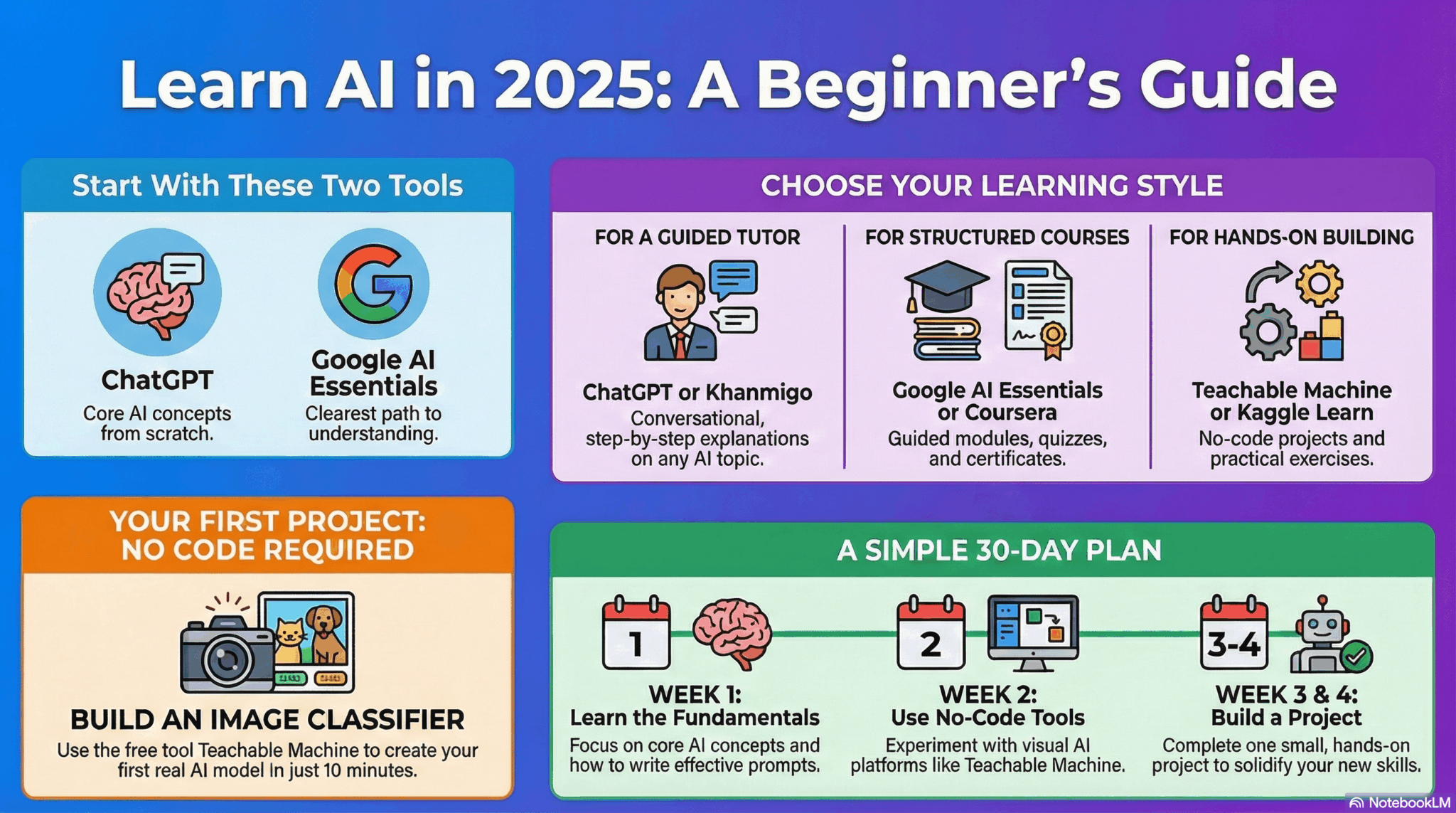
Why 2026 is the Best Time to Start with AI
Just a few years ago, AI felt like a “black box”—mysterious, intimidating, and reserved for tech giants. In 2026, AI has become multimodal and conversational, broadening its AI applications and making it the perfect time to explore easy AI tools for beginners with no experience.
The Shift to Natural Language
The biggest breakthrough for beginners has been the perfection of Natural Language Processing (NLP). You no longer need to learn “machine language.” You simply talk to your computer or phone in plain English (or any other language).
Statistics show that by 2026, over 70% of non-technical office tasks are being assisted by AI tools, yet the barrier to entry has never been lower. If you can send a text message, you can use 90% of the AI tools on the market today.
No-Code is the New Standard
We are living in the No-Code Revolution. Developers have spent years building “wrappers” and interfaces that hide the complexity of the underlying machine learning models. What’s left for you is a clean, “drag-and-drop” or “point-and-click” experience. This makes easy AI tools for beginners with no experience more accessible than a standard spreadsheet.
Top 5 Easy AI Tools for Beginners (No Experience Required)
If you are looking for a place to start, these five categories represent the “low-hanging fruit” of the AI world. They offer the highest reward for the lowest learning curve, making them ideal easy AI tools for beginners with no experience.
1. ChatGPT & Gemini: Your Personal Knowledge Assistants
By 2026, ChatGPT (OpenAI) and Gemini (Google), leading examples of Generative AI, have evolved into “Autonomous Agents.” They don’t just answer questions; they help you execute plans, serving as excellent AI assistants and easy AI tools for beginners with no experience.
Best for: Writing emails, planning vacations, summarizing long documents, and brainstorming ideas.
Why it’s easy: It’s a chat interface. You type a prompt like “Help me write a polite email to my landlord about a leaky faucet,” and it delivers a perfect draft in seconds.
Beginner Tip: Don’t just ask one question. Have a conversation. If the first answer isn’t perfect, say, “Make it sound more professional” or “Shorten it to three sentences.”
2. Canva Magic Studio: Design for the “Non-Designer”
Canva has revolutionized the creative world. Their Magic Studio uses AI to turn a simple text description into a full-blown social media post, presentation, or video, proving to be one of the most effective easy AI tools for beginners with no experience.
Best for: Social media graphics, birthday cards, business presentations, and photo editing.
Why it’s easy: You don’t need to know about layers, pixels, or color theory. You can use the “Magic Expand” feature to grow a photo or “Magic Grab” to move objects inside a picture as if they were stickers.
Key Feature: The “Text-to-Image” generator allows you to type “A cute cat wearing a space helmet in a watercolor style,” and it creates it for you instantly.
3. Perplexity AI: The Search Engine That Thinks
If you are tired of scrolling through pages of ads on traditional search engines, Perplexity AI is your new best friend. It acts as a research assistant that reads the internet for you, making it a prime example of easy AI tools for beginners with no experience.
Best for: Fact-checking, finding recipes, and learning new hobbies.
Why it’s easy: It provides a conversational summary of the best information on the web, complete with citations. You don’t have to click on ten different websites to find one answer.
4. Otter.ai & Fireflies: Never Take Notes Again
For anyone who attends meetings or lectures, these AI transcription tools act as invaluable virtual assistants, proving life-changing. They listen to your conversations and provide a perfect summary of what was said, standing out as truly easy AI tools for beginners with no experience.
Best for: Students, office workers, and journalists.
Why it’s easy: You simply hit “record” or invite the AI bot to your Zoom/Teams meeting. It identifies who is speaking and highlights the “action items” automatically.
5. Midjourney & DALL-E: The Power of Visual Imagination
While these started as “techie” tools, by 2026, their interfaces have become incredibly intuitive. You can now generate high-quality art by simply describing a scene, showcasing them as powerful yet easy AI tools for beginners with no experience.
How to Master AI with Zero Technical Skills: A Step-by-Step Guide
You don’t need a course; you need a mindset. Follow these steps to go from “AI Novice” to “AI Savvy” in less than a week, leveraging the power of easy AI tools for beginners with no experience.
Step 1: Start with “The Big Three”
Don’t overwhelm yourself by trying 50 different apps. Start with one text AI (ChatGPT), one search AI (Perplexity), and one visual AI (Canva). Spend 15 minutes a day playing with them.
Step 2: Learn the Art of the “Prompt”
In 2026, Prompt Engineering is just a fancy word for “talking clearly.” To get the best results from AI, follow the C.R.A.F.T. formula:
Context: Tell the AI who you are and what you’re doing.
Role: Tell the AI who it should be (e.g., “Act as a professional career coach”).
Action: Give a clear verb (e.g., “Write,” “Summarize,” “Analyze”).
Format: Tell it how you want the result (e.g., “A bulleted list,” “A 200-word essay”).
Target: Define your audience (e.g., “For a 10-year-old”).
Step 3: Use AI for Your Hobbies First
The best way to learn is through low-stakes activities. Ask AI to create a 4-week workout plan based on the equipment you have at home. Ask it to generate a meal plan based on the ingredients in your fridge. When you see the practical value in your personal life, using it for work becomes second nature.
Step 4: Embrace the “Iterative” Process
Beginners often give up if the AI doesn’t give a perfect answer on the first try. Remember: AI is a collaborator, not a vending machine. If the output isn’t right, talk back to it! Say, “That’s too formal, make it friendlier,” or “You forgot to mention the price.”
AI for Productivity: Saving 10+ Hours a Week
The real magic of easy AI tools for beginners with no experience is the gift of time, largely through effective workflow automation. In 2026, we are seeing a massive shift in how people manage their daily schedules.
Automating the Mundane
Think about the tasks you hate. Sorting emails? Scheduling appointments? Data entry? These are all areas where easy AI tools for beginners with no experience can significantly boost your productivity.
AI Email Assistants: Tools like Shortwave or SaneBox now use AI to prioritize your inbox, drafting replies to common questions before you even see them.
Scheduling Bots: Tools like Reclaim.ai use AI to look at your calendar and automatically find the best time for your habits, deep work, and meetings without you lifting a finger.
AI in Learning and Education
For beginners, AI is the ultimate tutor. If you are reading a complex article and don’t understand it, you can copy-paste it into an AI and say, “Explain this to me like I’m five years old.” This democratization of knowledge is the most powerful aspect of AI in 2026.
Overcoming the “Fear of AI”: Common Myths Debunked
It’s natural to feel hesitant. Let’s address the three biggest concerns beginners usually have.
Myth 1: “AI is going to replace me.”
Reality: AI isn’t going to replace humans, but humans who use AI will replace humans who don’t. Think of AI as a power tool. A carpenter with a power saw is more efficient than one with a hand saw, but you still need the carpenter to design the house.
Myth 2: “I’m not ‘tech-savvy’ enough.”
Reality: As we’ve discussed, the tech has met you halfway. In 2026, the interface is human language. If you can hold a conversation, you are “tech-savvy” enough for modern AI, and certainly capable of using easy AI tools for beginners with no experience.
Myth 3: “AI is always wrong (Hallucinations).”
Reality: While AI can sometimes make mistakes (called hallucinations), the models in 2026 are significantly more accurate than those of 2023. Always use AI as a starting point, not a final authority, and be mindful of ethical AI considerations. Always double-check important facts, especially in legal or medical contexts.
The Future of AI: What’s Next for Beginners?
As we move further into 2026, we are seeing the rise of Personal AI. Soon, your AI won’t just be a website you visit; it will be a personalized “Digital Twin” that knows your preferences, your schedule, and your writing style.
The transition from “using AI tools” to “living with AI assistance” will be seamless. By starting now with easy AI tools for beginners with no experience, you are building the foundational skills needed for the next decade of digital evolution.
Key Takeaways for 2026:
Simplicity is King: Choose tools with clean interfaces.
Voice is the New Keyboard: Don’t be afraid to talk to your AI.
Stay Curious: New tools are released weekly; keep an open mind.
- Privacy First: Always check the privacy settings of any tool you use to ensure your personal data stays yours.
Conclusion: Your AI Journey Starts Today
The world of Artificial Intelligence is no longer a distant future—it is our present reality. The “barrier to entry” has effectively vanished, especially for those seeking easy AI tools for beginners with no experience, leaving only a “barrier of curiosity.”
By experimenting with easy AI tools for beginners with no experience, you are doing more than just learning new software; you are expanding your potential. You are finding ways to be more creative, more productive, and more informed.
Don’t wait for the “perfect time” to learn. Open a tab, sign up for a free account on ChatGPT or Canva, and ask your first question. You’ll be amazed at how quickly the “intimidating” becomes “indispensable.”